

Disc golf might look simple from the sidelines, but once you step up to the tee pad, you quickly realize there’s more to it than meets the eye. One of the trickier aspects? Understanding how disc angles affect flight—especially when it comes to hyzer and anhyzer throws.
These terms often trip up newer players, but mastering them can add serious control and precision to your game.
In this guide, we’ll break down hyzer vs. anhyzer throws—what they are, when to use them, and how to throw them effectively.
Hyzer vs. Anhyzer: What’s the Real Difference?
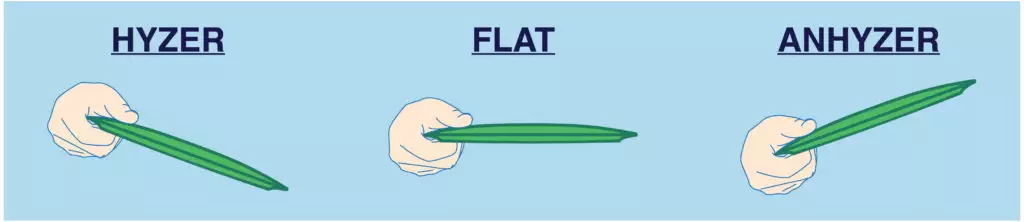
The key distinction between a hyzer and an anhyzer throw lies in the angle of the disc at the moment of release. In a hyzer throw, the top of the disc tilts away from the thrower. In an anhyzer throw, the top tilts toward the thrower.
Think of it like slicing a pizza at different angles—the direction your disc travels depends heavily on how you “cut” the air. A flat release, where the disc is level, serves as the baseline. Tilt the disc in or out, and you get dramatically different flight paths.
In Ultimate Frisbee, you’ll often hear similar terms: inside-out (hyzer) and outside-in (anhyzer).
What Is a Hyzer Throw?
Hyzer throws are considered the most reliable in disc golf. Why? Because they behave predictably—no surprises mid-flight. For a right-handed backhand (RHBH) player, a hyzer throw will naturally curve left. For a right-handed forehand, it’ll finish right. That consistent curve makes hyzers perfect for shaping shots around trees or obstacles.
Example: A left-handed player throwing a backhand hyzer would tilt the right edge of the disc down. Upon release, the disc arcs to the right.
How to Throw a Hyzer
If you’re looking to broaden your shot variety, learning to throw a clean hyzer is essential. Here’s a simple step-by-step:
- Grip the disc with the top angled slightly away from your body.
- Adjust your wrist so the edge closest to you is higher than the outer edge.
- Begin with about a 45-degree angle to get a feel for it.
- Release the disc smoothly, letting the outside edge drop lower than the inside.
Tip: When in doubt, go stable. A stable or slightly overstable disc offers great control on hyzer lines.
“The hyzer is the bread and butter of shot shaping.” – Paul McBeth
Understanding the Anhyzer Throw
Need your disc to drift the opposite way? That’s where the anhyzer comes in. Anhyzer throws are ideal for getting around objects or creating S-curve flex shots. For RHBH players, the disc will initially veer right before potentially fading back left—depending on the disc’s stability and power behind the throw.
Example: A left-handed player would tilt the right side of the disc upward. On release, the disc travels left, moving against its natural fade.
How to Throw an Anhyzer
The mechanics are similar to a hyzer, but you’ll flip the disc angle:
- Grip the disc with the top angled toward your body.
- Adjust your wrist so the outer edge is higher than the inner edge.
- Use a smooth follow-through, keeping that angle steady through the release.
Tip: An understable disc works best for anhyzer shots. It resists fading out too early and holds the anhyzer line longer.
“Understanding angle control is one of the keys to consistency.” – Nate Sexton
Why Use Hyzer and Anhyzer Throws?
1. Navigating Sharp Angles
Not every hole is a straight shot. When you’re facing a dogleg left or right, using a hyzer or anhyzer lets you shape your throw to match the course design.
Tip: Check out our guide on drivers designed for sharp-angle control.
2. Getting Around Obstacles
Trees, bushes, or elevation changes can block your direct line to the basket. Instead of forcing a bad shot, use a hyzer or anhyzer to curve around the obstacle.
Tip: Disc selection matters. Check out our recommended discs for different skill levels to help match your disc to your shot style.
3. Maximizing Distance with Flex Shots
Want more distance without changing your throw style? Flex shots use an anhyzer release with an overstable disc to create an S-shaped flight path. The disc turns one way before fading back, covering more ground.
Alternatively, an understable disc thrown on a hyzer angle with enough power will flip to flat and continue on an anhyzer line before fading out slightly—another excellent way to stretch your distance.
Tip: Use flight numbers to your advantage. Discs with high turn (-3 or more) and moderate fade (1–2) are ideal for shaping long flex shots.
Stat to know: According to UDisc, players can gain 15–30% more distance using well-executed flex lines over flat releases.
Wrapping It All Up
Hyzer and anhyzer throws aren’t just technical jargon—they’re essential tools for shaping shots, avoiding trouble, and adding creativity to your game. The angle at which you release the disc can completely change its flight path, giving you more control over each throw.
Want to keep refining your skills? Explore more on our disc golf blog for technique tips, disc reviews, and gear recommendations.
Remember: It’s not just about how far you can throw, but how well you can shape your shot.



I wonder: if I drink two or three Anheuser-Bush beers, will it help my anhyzer throws ?
It will make you more likely to throw your anhyzer into a bush.
I think its absolute genius to provide examples that apply to left-handed people when a much greater percentage of the population is right handed!! Brilliant!
One of the nice things about disc golf is that the same spinning motion is achieved by both right and left handed players.
A right handed player throwing forehand achieves the same flight path as a left handed player throwing backhand.
So a hyzer throw has top of the disc away from you, but your picture shows the opposite?
With a Hyzer Throw, the outside edge of the disc furthest from your hand points downward. The distance away from you isn’t really relevant, as it is the angle of the disc at release that matters.
Great post. FYI in Ultimate, an outside-in (anhyzer) backhand is also called a “bender.”